Sign up for the On Point newsletter here.
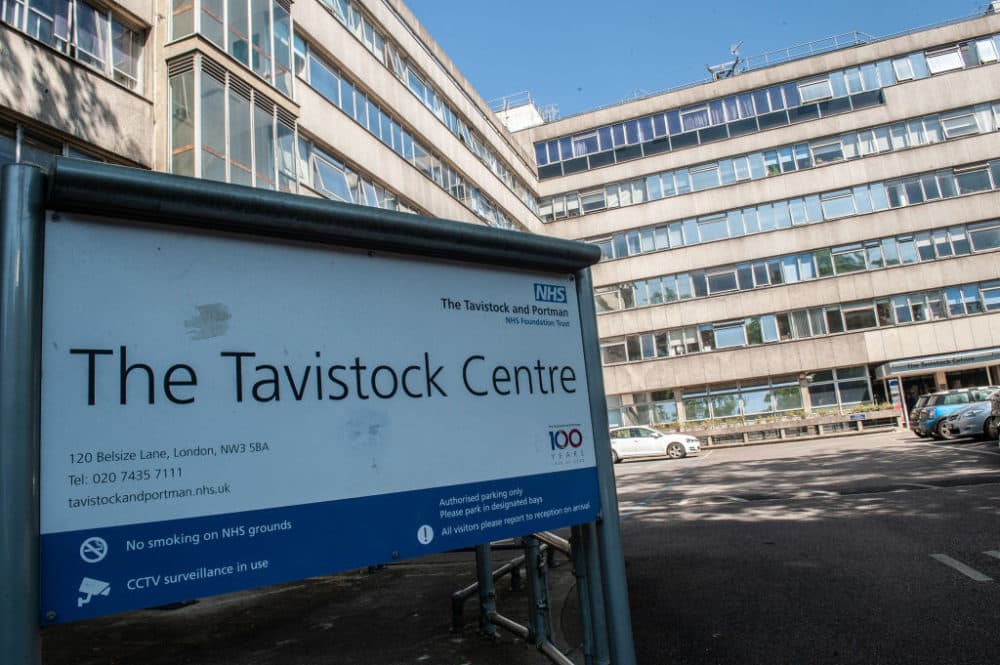
The United Kingdom’s only dedicated gender identity clinic opened nearly 35 years ago.
In recent years, those inside the clinic began to raise concerns.
After a scathing independent review, the National Health Service decided to close the clinic.
Today, On Point: Journalist Hannah Barnes tells us what happened.
REED: I do not believe that the quality standard of care to medicalize a child with interventions that are lifelong, that can impact their fertility for life, that the quality of care is two visits with a kid.
CHAKRABARTI: Now, Jamie Reed herself identifies as a queer woman. She is married to a trans man and says that she firmly supports trans rights and has previous experience working with trans youth in clinical environments. She says her concerns, though, were not taken seriously by leadership at the Washington University Center.
REED: Part of the problem with this kind of care right now is it’s become … this huge extreme thing where you can’t say anything questioning this care without. I mean, I’ve basically been told that I’m going to be, like, responsible for children’s deaths. You cannot question a care model, and that is not how medicine is supposed to work. Medical staff are supposed to be the people in the room with the doctors who see things going on and have the backup of the medical institution to be able to say, Hey, pause, timeout. Something’s not going right here. Without being absolutely vilified. From every angle.
CHAKRABARTI: That’s part of our conversation with Jamie Reed, and a longer version will be available in our podcast feed later this week. Now, following Reed’s accusations, Missouri’s Republican Attorney General Andrew Bailey launched an investigation into the facility at Washington University. And as a result, Washington University is not commenting. The St Louis Post-Dispatch and Missouri Independent have spoken with families who report positive experiences at the center.
… Now, Hannah Barnes, again, just to put a fine point on it, here in the United States right now, we’re in a political environment where, you know, in some places like Florida there even, you know, the legislature there is considering violating people’s First Amendment rights by banning preferred pronouns. We have other states in the United States, Tennessee, Texas, more who are contemplating making seeking care for gender questioning youth equivalent to child abuse.
So we have parents who are concerned about their children being taken away from them. So it does very much feel like an existential threat, as I said earlier, to members of the trans community. I’m wondering what the political environment around this issue of quote-unquote, gender affirming care is like in the United Kingdom.
CHAKRABARTI: Well, fortunately, not like that. No, I mean that’s appalling, isn’t it? And as Jamie Reed said, there so many things. You have so many parallels with what clinicians have said and have told me about their time at the Tavistock. And I think I hope that books like mine, that testimony like Jamie Reed’s and like Anna Hutchinson and others, and of course, leading trans doctors themselves, like Marci Bowers in the position she has … everybody working in this field really wants the same thing, which is the best care possible for each and every one of those young people.
Making transition as safe and positive as possible for those for whom it will be the right option, and preventing those for whom it won’t be going down that path and making their lives better as well. And it’s about having a calm conversation where you can question the standard of care being provided to a group of young people without questioning them themselves, without questioning their identity or their rights, and doing that without being vilified.
And for those concerns to be taken in the spirit in which they’re intended, which is from concerned mental health practitioners or clinicians who have dedicated their entire working lives to helping young people, it’s just not credible to write them off as transphobic. But we are fortunate here in the U.K., it’s obviously very heated as well. But we don’t have laws going through our Parliament or even proposed that pronouns shouldn’t be respected, or that care be taken away.
CHAKRABARTI: … I understand that you had trouble finding a publisher or even someone to do the cover art for your book, is that right?
BARNES: The cover art thing is a bit of a misnomer, but yes, it’s been widely reported here in the U.K. that the proposal, which was very detailed in itself, and we’d been looking at this together my colleague Deborah Cohen and I for Newsnight for well close to two years. I wrote a 17,000-word book proposal and it was rejected by 22 publishers. And interestingly, the responses didn’t they weren’t negative. They didn’t say, No, this is this is something we don’t want to do. Just really this is an important story. But not for us.
And actually, almost half didn’t reply at all, which I’ve been told by my very experienced agent is almost unheard of to get a rate of, you know, almost a half of norm responses. I mean, you’d expect 90% to reply. So it was, it was pretty demoralizing for a while. But fortunately, Swift Press … did want to take it on and I’m delighted that they have. And it’s a Sunday Times bestseller, so I’m really grateful to everyone that’s read it and bought it.
CHAKRABARTI: And for the people who spoke with you both.
BARNES: Oh, absolutely. Yeah. There’ll be no book without any of those people, and particularly the young people who went through. It’s both those who had a great experience and are happily transitioned and those who didn’t and frankly have been harmed and those clinicians as well. And I’m so grateful to each and every one of them.