I was wandering around Strawberry Banke yesterday in Portsmouth and came upon this edifying poster, which you might need to blow up to read. There were 18 million registered victory gardens furing WW2, and the government helped teach people how to grow food. I doubt they will be teaching us much during the next food crisis. “By the end of the war, nearly half the country’s fresh produce was grown in victory gardens like this”
https://www.agweb.com/news/business/shrinking-slice-farmers-receive-less-6-cents-every-food-dollar
For the past two years, USDA has estimated farmers and ranchers received less than 6 cents of every food dollar. In 2023, that was 5.9 cents, and using the latest data from 2024, it’s 5.8 cents.
“Our oldest data point right now is 2007 [USDA updated the data series] and that’s 14.7 cents per dollar, and now we’re down all the way to 11.8 cents per dollar,” says Faith Parum, economist with the American Farm Bureau Federation. “So we’ve really seen that decline year after year. It reflects how much of the value of things in the grocery store or when you go out to eat is going to other parts of the supply chain and not necessarily to farmers and ranchers.”
The aggregate decline masks a widening gap between sectors. While the overall farmer share is down, livestock and crop producers are seeing divergent trends:
- Crop Farmers: Share dropped from 2.9 cents to 2.5 cents (a 2.5% year-over-year decrease).
- Livestock Producers: Share increased from 3 cents to 3.3 cents.
“Overall, the farmer share is down. But we have those two markets really at odds,” Parum says. “We’ve seen that tale of two farm economies where our livestock producers maybe have seen a little bit of better days than they had had in the past, while our row crop farmers and our specialty crop farmers are really facing strong headwinds in the market.”
As highlighted by USDA, farm finances are quickly strained when farmers/ranchers are capturing a small percentage of the food dollar and even modest swings in commodity prices and/or input prices take place.
Parum adds, “when we talk about the health of our farms and the health of future generations on the farm, and being economically viable and sustainable and being able to keep their operations open, the trends we’re seeing right now are really hard for those farmers. Our ranchers are seeing a little bit of better days right now with high beef prices, but that’s not going to last forever, and with production expenses continuing to increase, we’re really going to see that that question come up of, what is sustainable if, if these dollars we’re spending in the grocery store aren’t making it back to our farmers.”
The key takeaway: farmers produce the raw commodities that make food production, however, the price is clearly more determined by what happens after the products first leave the farm.
The USDA Food Dollar Series tracks how each dollar is spent by consumers and then divides it across the industries contributing to the value in the supply chain, such as farming, food processing, transportation, packaging, wholesaling, retail and food service. As noted by the USDA, with each step in the process, the additional services, labor, transportation and infrastructure add value and increase costs to the final food product.
USDA’s Economic Research Service Food Dollar Series shows in 2024, farmers received 11.8 cents of every dollar spent on domestically produced food, the remaining 88.2 cents of the food dollar went toward the ‘marketing bill’, which includes costs associated with food processing, transportation, packaging, wholesaling, retailing and food service. Over time, this shift illustrates how an increasing share of food spending is driven by services and supply chain activities rather than farm production itself.
Farmers’ share of consumer food spending varies widely depending on the type of food purchased. For example, the farm share of the food-at-home dollar was 18.5 cents in 2024, up slightly from 18.4 cents in 2023. But even in this category it means only that one-fifth of what consumers spend on groceries goes back to farmers.
As you may expect, products with minimal processing, require less of the value to be retained in that part of the food system, and therefore return a larger share of the food dollar to producers.
“The highest commodity that gets the most of that food dollar is fresh eggs,” Parum notes. “That’s just because there’s limited labor to process that food.”
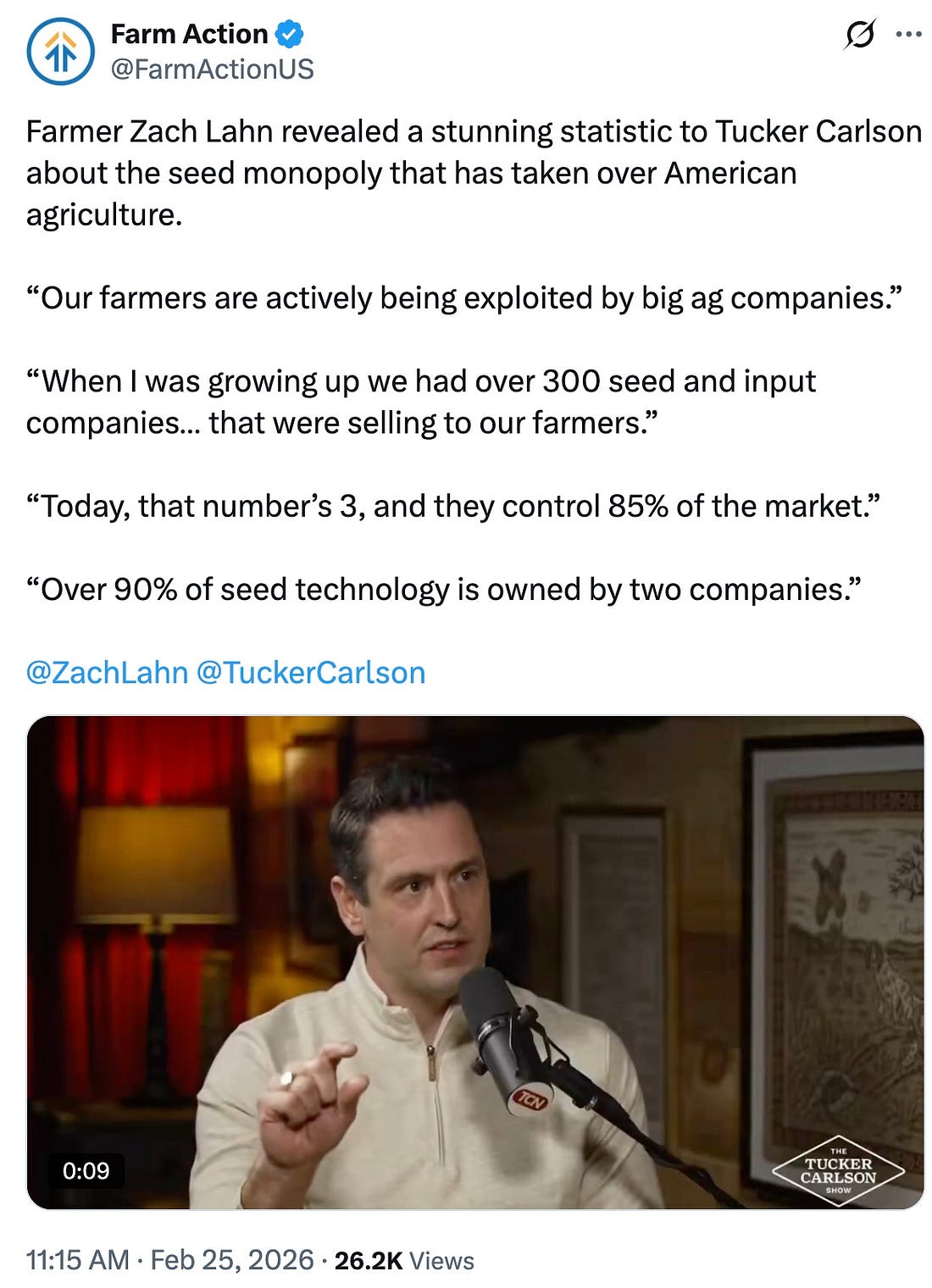
You know that one of the two companies who has monopolized seeds is Bayer/Monsanto: