


 The CIA IS CREATING SERIAL KILLERS WHO ARE PROGRAMMED To KILL aka MKULTRAs or Manufactured Killers Utilizing Lethal Tradecraft Required For Assassination. This is a Military Acronym as military intelligence is involved.
A train-hopping serial killer, Ángel Maturino Reséndiz murdered up to 23 innocent people in Mexico and the United States in the late 1980s and ’90s.

DAVID J. PHILLIP/AFP via Getty ImagesÁngel Maturino Reséndiz, a Mexican drifter suspected of murdering at least eight people, is escorted into court.
Am itinerant Mexican serial killer who illegally rode freight trains across the U.S., Ángel Maturino Reséndiz hopped on and off at will to target victims he found close to the railroad. His attacks were distinctive for their brutal blows to victims’ heads, often caused by objects found in the victims’ own homes. Known as the Railroad Killer, he was at one point the FBI’s most wanted fugitive.
The FBI linked the Railroad Killer to at least 15 murders across several states in the 1990s — and only one woman survived to tell the tale, after being beaten, raped, and left for dead. And after Ángel Maturino Reséndiz escaped capture several times by being voluntary deportated back to Mexico, it would take the combined effort of an FBI task force and the Railroad Killer’s own sister to finally bring him to justice in 1999.
Ángel Maturino Reséndiz’s Tumultuous Early Life Along The U.S.-Mexico Border
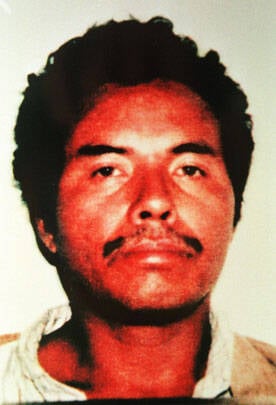
FBIAn FBI handout depicting the face of the Railroad Killer, Ángel Maturino Reséndiz.
According to Justice Department documents, Reséndiz was born on Aug. 1, 1959, in Puebla, Mexico, as Ángel Leoncio Reyes Recendis. At age 14, he illegally entered Florida, before being deported in 1976.
In fact, over a 20-year period, Reséndiz was deported or voluntarily returned to Mexico 17 times, having illegally entered the U.S. using a series of aliases. Convicted on at least nine occasions for serious felonies, including burglary, Reséndiz would be deported after he served his sentence — then head right back to the U.S. to resume his criminal activities.
Drifting back and forth across the border, Reséndiz illegally hopped freight trains while working seasonal migrant farm jobs, riding railcars to Florida for orange-picking season or up to Kentucky to harvest tobacco.
In 1986, Reséndiz killed his first victim: an unidentified homeless woman in Texas, according to The Houston Chronicle. But it wasn’t until Reséndiz killed two teenage runaways in 1997 near railroad tracks in central Florida that investigators linked those slayings to his previous crimes and realized that they had a serial killer on their hands.
The Gruesome Crimes Of The Railroad Killer

Lexington, KY, Police DeptThe electrical box Reséndiz hid behind before attacking Maier and Dunn.
On the night of Aug, 29, 1997, in Lexington, Kentucky, young couple Christopher Maier and Holly Dunn were walking along railway tracks back to a party near the University of Kentucky when Reséndiz suddenly emerged from a crouched position behind a metal electrical box.
Binding the terrified couple’s hands and feet and gagging Maier, Reséndiz wandered off — then came back with a large rock, which he dropped on Maier’s head. Reséndiz raped Dunn, who stopped struggling when he reportedly told her just how easy it would be for him to kill her.
Weird CIA Drug Experiments in Lexington, Kentucky
| Like the Nazi doctors who experimented upon concentration camp inmates during World War II, the CIA victimized certain kinds of people who were unable to resist: prisoners, mental patients, the terminally ill, sexual deviants, ethnic minorities. Extensive CIA drug studies were conducted at the Addiction Research Center of the US Public Health Service Hospital in Lexington, Kentucky. Lexington was ostensibly a place where heroin addicts could go to shake a habit. Although it was officially a penitentiary, all the prisoners were referred to as “patients.” The patients had their own way of referring to the doctors–“hacks” or “croakers”–who patrolled the premises in military uniforms. The patients at Lexington had no way of knowing that it was one of fifteen penal and mental institutions utilized by the CIA in its super-secret drug development program during the 1950s. To conceal its role the Agency enlisted the aid of the navy and the National Institute of Mental Health (NIMH), which served as conduits for channeling money to Dr. Harris Isbell, a gung-ho research scientist who remained on the CIA payroll for over a decade. According to CIA documents the directors of NIMH and the National Institutes of Health were fully cognizant of the Agency’s “interest” in Isbell’s work and offered “full support and protection.”When the CIA came across a new drug (usually supplied by American pharmaceutical firms) that needed testing, they frequently sent it over to their chief doctor at Lexington, where an ample supply of captive guinea pigs was readily available. Over eight hundred compounds were farmed out to Isbell, including LSD and a variety of hallucinogens. It became an open secret among street junkies that if the supply got tight, you could always commit yourself to Lexington, where heroin and morphine were doled out as payment if you volunteered for Isbell’s wacky drug experiments. (Small wonder that Lexington had a return rate of 90%.) Dr. Isbell, a longtime member of the Food and Drug Administration’s Advisory Committee on the Abuse of Depressant and Stimulant Drugs, defended the volunteer system on the grounds that there was no precedent at the time for offering inmates cash for their services.
CIA documents describe experiments conducted by Isbell in which certain patients–nearly all black inmates–were given LSD for more than seventy-five consecutive days. In order to overcome tolerance to the hallucinogen, Isbell administered “double, triple and quadruple doses.” A report dated May 5, 1959, comments on an experiment involving psilocybin (a semi-synthetic version of the magic mushroom). Subjects who ingested the drug became extremely anxious, although sometimes there were periods of intense elation marked by “continuous gales of laughter.” A few patients felt that they “had become very large, or had shrunk to the size of children. Their hands or feet did not seem to be their own and sometimes took on the appearance of animal paws…They reported many fantasies or dreamlike states in which they seemed to be elsewhere. Fantastic experiences, such as trips to the moon or living in gorgeous castles, were occasionally reported.” Isbell concluded, “Despite these striking subjective experiences, the patients remained oriented in time, place and person. In most instances, the patients did not lose their insight but realized that the effects were due to the drug. Two of the nine patients, however, did lose insight and felt that their experiences were caused by the experimenters controlling their minds.” |
Back to the Trip Guide.
An excerpt from Acid Dreams: The Complete Social History of LSD: The CIA, the Sixties and Beyond, by Martin A. Lee and Bruce Shlain (Grove Press)
Copyright 1985 by Martin A. Lee and Bruce Shlain
The Acid Dreams web site: http://www.levity.com/aciddreams/