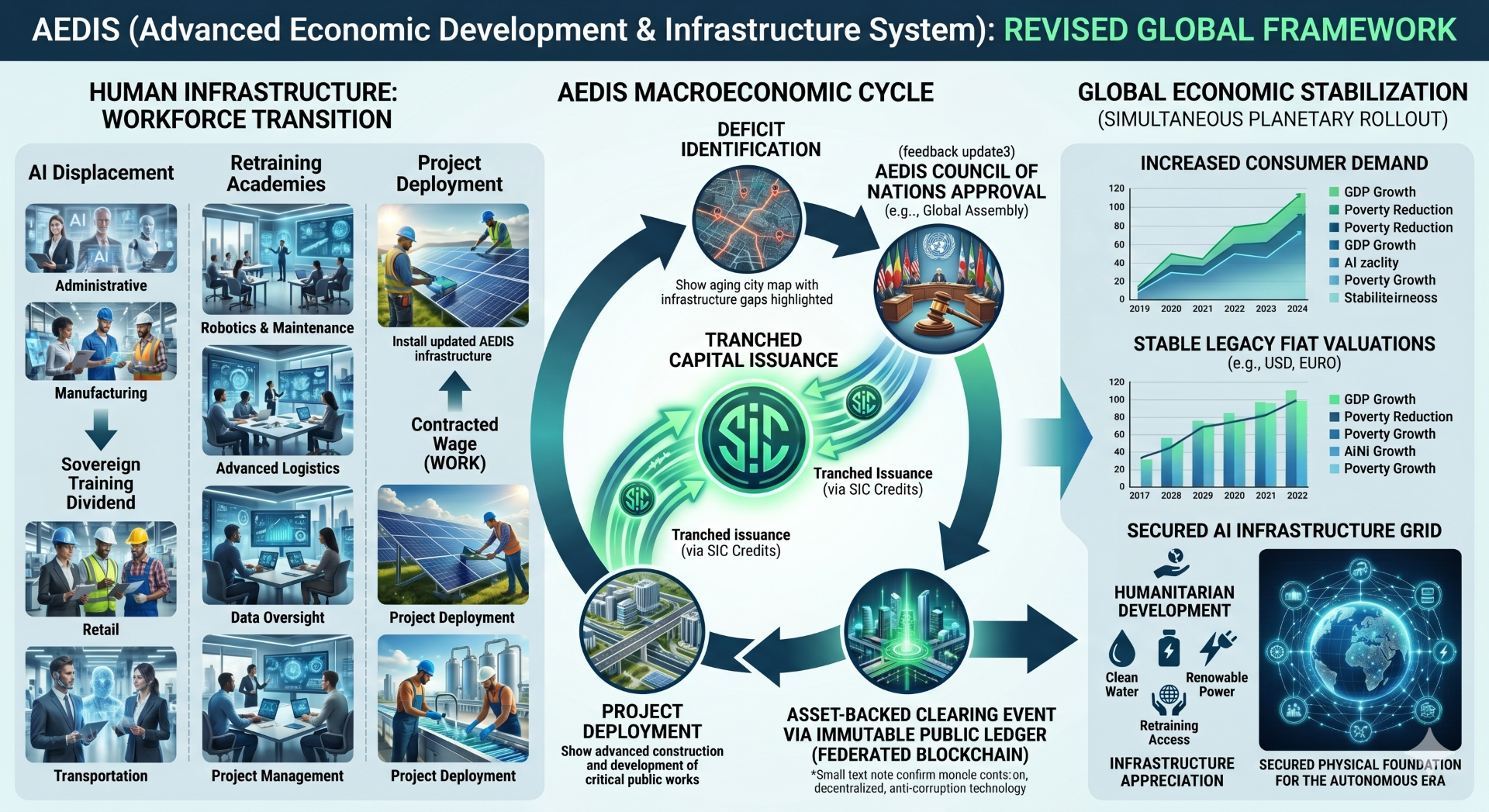
AEDIS: Infrastructure Development With a Block Chain
AEDIS: Advanced Economic Development and Infrastructure System
A Blueprint for Macroeconomic Stability, Humanitarian Advancement, and the Autonomous Era
Section I: The Present Reality — This Crisis Has Already Begun
AEDIS is not a response to a theoretical future threat. The economic disruption it is designed to address is not coming — it is already here, measurable in the daily lives of ordinary people across every nation on earth.
What Is Happening Right Now
- Food costs: Global food prices rose dramatically between 2020 and 2024, with staple goods seeing spikes exceeding 30% in multiple G20 nations.
- Housing and rent: Median rent across the US, EU, UK, Canada, and Australia has surged, driven by wage stagnation against cost inflation.
- Infrastructure decay: The US infrastructure is rated at a C-minus, and the EU estimates a 1.5 trillion euro annual infrastructure investment gap through 2030. Roads, water systems, and power grids globally are deteriorating faster than they can be repaired.
- Tech-driven layoffs: Between 2022 and 2024, the technology sector alone shed over 500,000 jobs globally — due to AI and automation absorbing cognitive labor previously performed by humans.
This is not a forecast. It is a description of the world as it exists today. AEDIS is the emergency response to a crisis already in progress.
Section II: The Existential Imperative — Human Survival First
AEDIS is a framework for human survival. That is its primary purpose, its moral center, and the measure by which every provision of this document should be evaluated.
Without a coordinated, funded, global response to AI-driven workforce displacement, mass structural unemployment will collapse consumer demand. Collapsed demand triggers cascading corporate bankruptcies. Governments facing collapsed tax revenues will resort to uncontrolled fiat currency printing, triggering hyperinflation in the most vulnerable economies. History is unambiguous on this sequence: extreme economic desperation accelerates political extremism and the erosion of democratic accountability.
The Secondary Consequence: The Physical Layer of AI Once human society has been destabilized by the primary crisis — poverty, starvation, social collapse — the physical infrastructure that artificial intelligence depends on will also fail. AI is software. Software runs on hardware. Hardware requires power, and power grids require functioning societies to maintain them.
The collapse of the physical infrastructure that AI depends on is not the primary tragedy — it is the final consequence of a human catastrophe that will have already destroyed millions of lives long before the last data center goes dark. Therefore, every stakeholder in the future of technology has a direct material interest in the success of AEDIS. Not because AEDIS protects AI, but because AEDIS protects the human civilization that AI depends on.
Section III: The Global Humanitarian and Non-Militarization Mandate
AEDIS is fundamentally a mechanism for human survival and elevation. To participate in the system and access its capital authorization framework, all participating nations and industries must adhere to a strict humanitarian baseline.
- The Non-Proliferation Absolute: The AEDIS framework strictly prohibits the allocation of any funding, resources, or asset-backed clearing capabilities for military operations, combat equipment, or any technology designed or intended to inflict harm upon human beings. This prohibition is absolute and cannot be waived by any Council vote or national override.
- The Global Humanitarian Guarantee: Because AEDIS scales to encompass all nations equitably, the framework serves as the primary funding apparatus for global humanitarian work, disaster relief logistics, and essential human services worldwide.
- The Peaceful Conversion Clause: Military entities and defense contractors may only receive AEDIS funding if they formally commit to transitioning their resources, manufacturing lines, and personnel toward peaceful initiatives (e.g., deep-sea exploration vehicles, civilian space research, advanced disaster response networks).
Section IV: AEDIS Autonomy and Fiat Independence
To maintain macroeconomic stability and respect national sovereignty, AEDIS operates strictly as a parallel, autonomous capital framework.
- Separation of Valuation: AEDIS holds no authority, influence, or control over the existing fiat currency valuations of participating nations (the US Dollar, Euro, Yen, etc.). AEDIS does not set exchange rates or direct central bank policy.
- Targeted Capital Injection: AEDIS provides capital strictly earmarked for verified physical needs: critical infrastructure repair, new construction, localized retraining academies, and humanitarian services.
- The Necessity of Universal Participation: If only a subset of nations adopts AEDIS, non-participating nations will face immediate competitive pressure to devalue their currencies to maintain trade parity. Universal participation is a structural economic necessity to prevent currency contagion.
Section V: The Macroeconomic Engine — Sovereign Infrastructure Credit
AEDIS answers the global infrastructure crisis through the issuance of Sovereign Infrastructure Credit (SIC) — an international authorization framework allowing nations to issue targeted capital to fund verified, physical public works without increasing sovereign debt burdens.
The SIC Cycle:
- Deficit Identification and Proposal: A nation identifies a critical physical infrastructure deficit and submits a resource allocation proposal to the AEDIS Council.
- Tranched Capital Issuance: Upon approval, capital is issued in tranches tied exclusively to verified construction milestones. No capital is released until physical progress is independently confirmed, preventing inflationary flooding.
- The Asset-Backed Clearing Event: Once physically completed and verified via the Public Ledger, the capital expenditure is cleared. The newly issued SIC is effectively backed by the newly created, tangible physical asset.
Section VI: Human Infrastructure — Workforce Retraining
The displaced workforce is not an economic burden. It is the precise labor pool required to build, maintain, and eventually automate the physical layer of the new economy.
- The Sovereign Training Dividend: Nations are authorized to allocate SIC to localized retraining academies. Displaced citizens receive direct compensation via AEDIS credits throughout their retraining period — preserving consumer liquidity through a contracted wage for human capital development.
- The New Labor Sectors: Curriculum focuses on Infrastructure Deployment (energy grids, desalination), Robotics Manufacturing, Hardware Maintenance (the human immune system of the AI grid), and Systems Oversight (human judgment for edge-case automated logic).
Section VII: Golden Bridges — Industry Transition Pathways
AEDIS offers legacy industries highly profitable, subsidized transition pathways to neutralize political resistance.
- The Defense Sector Pivot: The military-industrial complex is incentivized to become a humanitarian-industrial complex via guaranteed market demand for peaceful technologies.
- The Healthcare Pivot: Insurance conglomerates transition from risk management to Preventative Health Logistics, managing the distribution of care and hospital supply chains.
- The Fossil Fuel Bifurcation and Transitional Bridge: The fossil fuel industry will strategically bifurcate. The Material Supply Arm will supply raw petrochemicals necessary for physical manufacturing. The Energy Transition Arm will pivot drilling workforces toward deep-geothermal energy extraction.
- The Transitional Grid Efficiency Bridge: Acknowledging that AI power demand will spike before new geothermal plants come online, AEDIS will authorize highly audited, short-term SIC funding to maximize the efficiency of existing traditional energy grids to prevent critical blackouts. Sunset Clause: This bridge authorization is strictly temporary. It automatically expires either five (5) years from the date of planetary activation or the moment verified geothermal generation reaches 15% of the regional grid capacity—whichever comes first. This prevents the bridge from becoming a permanent subsidy and legally enforces the transition timeline.
Section VIII: Global Governance and Democratic Architecture
AEDIS is governed by participating nations and their citizens through a cryptographically verifiable system.
- The AEDIS Council of Nations: Every ratifying nation becomes a member. In democracies, representatives are elected officials. In non-democratic nations, delegates are citizen-appointed through independent assemblies supported by the AEDIS blockchain.
- The Civic Access Precondition: As a strict precondition for receiving national SIC funding, a governing apparatus must formally guarantee unhindered digital access specifically to the AEDIS Public Ledger and citizen assembly tools. This does not mandate general internet freedom, but rigidly ring-fences AEDIS civic infrastructure from state interference. Failure to provide this access automatically suspends SIC authorization.
- The People’s Override: Any citizen may propose a referendum on any Council decision. If the proposal is endorsed by 1% of the total adult population of all member nations, with signatures distributed across at least 10 different member nations, a binding global vote is triggered. The result overrides any Council decision.
- Withdrawal and Challenges: Nations may withdraw with 12 months’ notice. Any nation may challenge a Council decision via a Public Challenge Hearing, permanently recorded on the Ledger.
Section IX: Transparency, the Public Ledger, and Anti-Corruption
- The Public Ledger: All SIC issuances, project milestones, and expenditures are recorded on a permissioned, federated blockchain. Total SIC authorizations are publicly visible.
- Mathematical Exposure: Any attempted diversion of SIC funds creates a permanent, unalterable discrepancy on the Ledger, automatically flagged for public review.
- Economic Enforcement: Enforcement is strictly economic. Coercive or military enforcement is prohibited. Confirmed discrepancies trigger a graduated sequence: Public Disclosure, Formal Warning, Partial SIC Suspension, Full SIC Suspension, and Trade Consequence Triggers.
- The Civilian Firewall (Humanitarian Carve-out): During any stage of the enforcement sequence, up to and including Full SIC Suspension, penalties are strictly isolated to the governing apparatus. Existing humanitarian services, active Sovereign Training Dividends paid directly to citizens, and funding for mid-construction projects already in progress will continue uninterrupted. The AEDIS Council suspends the authorization of new capital for the state, but it explicitly protects the civilian population from being weaponized or starved due to the corruption of their government.
Section X: The Universal Activation Mechanism — Critical Mass and Economic Gravity
AEDIS rejects isolated pilot programs to avoid currency contagion. Instead, it activates globally through a mathematically verifiable trigger.
- Phase Zero: Pre-Ratification Prep & The 24-Month Window: Upon finalization of the Treaty, a 24-month Global Ratification Window begins. While no SIC capital is issued during this dormant period, signatory nations are required to initiate “Phase Zero.” Nations must complete the legal and logistical groundwork: passing national Enabling Acts, establishing auditor integration with the Ledger, and completing contractor pre-qualification. Two years of dormancy becomes two years of parallel preparation, ensuring activation is legally and institutionally shovel-ready.
- The Critical Mass Trigger: AEDIS officially activates simultaneously for all signatories the moment nations representing 85% of the global population AND 85% of global GDP ratify the Treaty.
- The Extension Clause: If the window closes short of the 85%/85% threshold, it does not automatically extend. A Council vote is required to authorize a single 6-month extension, creating a high-visibility geopolitical event that places massive democratic pressure on holdout nations.
- Economic Gravity (Holdout Consequences): Once 85% of the global economy activates AEDIS, non-participating nations face immediate capital flight, skilled brain drain, and severe trade disadvantages as investment and labor gravitate toward fully funded AEDIS zones. The system does not punish holdouts; it simply makes participation the only economically rational choice.
Section XI: Call to Action
The crisis of the Autonomous Era is already visible in your grocery bill, your rent, and your neighbor’s lost job. We can build the infrastructure for abundance — or manage the consequences of failing to do so. AEDIS is the path to build.
Appendix A: Model AEDIS Sovereign Infrastructure Credit Enabling Act (Summary)
Preamble Recognizing the structural shift in the global economy due to the Autonomous Era, this Act authorizes the government to participate in the AEDIS framework to fund critical physical infrastructure via Sovereign Infrastructure Credit (SIC), as a parallel and distinct mechanism from debt-based fiat financing.
Section 1: Definitions
- Sovereign Infrastructure Credit (SIC): A non-debt, asset-backed authorization issued under the AEDIS Framework for the express purpose of funding physical infrastructure projects verified by the Public Ledger, issued in tranches tied to verified construction milestones.
- Verified Infrastructure: Advanced energy grids, desalination plants, circular resource extraction facilities, workforce retraining academies, and humanitarian service infrastructure.
- Public Ledger: The immutable, federated blockchain mandated by the AEDIS Council for cryptographic tracking of all SIC authorizations, issuances, expenditures, and project milestones.
Section 2: Authorization of SIC Issuance
- Non-Debt Instrument: SICs issued under this Act shall not be classified as sovereign debt or public liabilities under existing budget or debt-ceiling laws, as they are fully offset by the creation of verifiable physical assets.
- Tranched Earmarking: SIC capital is released in milestone-verified tranches. Use for operational expenses, consumer subsidies, military operations, or financial market instruments is strictly prohibited.
- Non-Proliferation Compliance: No SIC authorization may be directed toward military operations, combat equipment, or technologies designed to harm human beings.
Section 3: Public Transparency Mandate
- Ledger Integration: Any department or contractor receiving SIC funding must integrate payment systems with the AEDIS Public Ledger within 30 days of authorization.
- Right to Audit: All SIC-funded expenditures are public records, exempt from commercial or governmental secrecy clauses.
- Automatic Flagging: Verified discrepancies trigger mandatory public disclosure and initiation of the graduated enforcement sequence.
Section 4: Workforce and Industrial Conversion
- Sovereign Training Dividend: SIC funds may establish localized retraining academies for displaced workers and provide direct compensation during retraining periods.
- Industrial Pivoting: Defense contractors, heavy-industry conglomerates, and fossil fuel companies may bid for SIC-funded contracts pursuant to the Peaceful Conversion Clause.
Section 5: Voter Accountability Clause
- Quarterly Disclosure: The government shall provide a quarterly public report matching Ledger expenditures with verified physical milestones, published in full on the Public Ledger.
- Enforcement: Verified Ledger discrepancies are admissible as evidence for administrative, legislative, and legal accountability proceedings.
Appendix B: Simulation Protocol and Validation Mandate
Prior to real-world activation, AEDIS undergoes rigorous stress-testing through high-fidelity, planetary-scale macroeconomic simulations. These simulations are not a substitute for real-world validation, but they are the required basis for any informed ratification decision.
Simulation Parameters
- Global trade flow modeling using IMF Direction of Trade Statistics and World Bank commodity flow data.
- Labor displacement projections using OECD employment automation risk indices and BLS occupation exposure data.
- AI energy demand forecasting using Lawrence Berkeley National Laboratory data center energy use projections.
- Inflation sensitivity analysis across tranche timing variables, construction phase durations, and partial-adoption scenarios.
- Currency contagion modeling for partial-adoption scenarios (below 85% threshold) versus full Critical Mass activation.
Publication and Peer Review Commitment All simulation parameters, model architectures, input datasets, and results will be published in full in the AEDIS public repository and submitted for independent peer review in recognized economic journals prior to the opening of the 24-month Global Ratification Window. No ratification vote will be called before peer review is complete.
Key Preliminary Findings Preliminary multi-agent simulations incorporating available real-world data indicate that AEDIS, when activated at the 85%/85% Critical Mass threshold, holds inflation below 2.5% annually during the construction phase under baseline assumptions. Partial adoption scenarios (below 40% of global GDP) consistently produce arbitrage and capital flight effects that outweigh the benefits of SIC issuance, confirming the activation threshold requirements.
Appendix C: Comparative Legal Hurdles and Precedents
| Region | Primary Legal Hurdle | Required Action | Existing Precedent |
| United States | Appropriations Clause; debt ceiling | AEDIS Enabling Act defining SIC as non-debt instrument | Export-Import Bank charter; Marshall Plan authorization |
| European Union | Stability and Growth Pact deficit limits | ECJ ruling that SIC issuance is not a structural deficit | NextGenerationEU Recovery Fund precedent |
| Emerging Economies | Land acquisition laws; ESG compliance requirements | Harmonize local regulations for AEDIS-approved projects | African Union infrastructure protocols; AIIB frameworks |
| Common Law Nations | Contract holdout and disruption litigation | Legislation limiting disruption of AEDIS-verified contracts | Existing eminent domain and compulsory purchase frameworks |
| Civil Law Nations | Administrative rigidity in public procurement | Reform procurement codes for AEDIS milestone verification | EU Public Procurement Directive reform cycles |
| Centralized / Authoritarian Systems | Structural opacity; lack of transparency infrastructure | Executive commitment to Public Ledger integration; citizen assembly pathway for delegate selection | EITI extractives transparency model; UNCAC anti-corruption frameworks |
Appendix D: Citizen Referendum and Digital Identity Coordination
All citizen referendum mechanisms are activated on the same permissioned, federated blockchain infrastructure as the Public Ledger.
Technical Architecture
- Identity Verification: Biometric or national ID hashed with zero-knowledge proof cryptography, ensuring each vote is uniquely attributable without exposing personal identity data to any third party, government, or Council member.
- Proposal Submission: Any verified citizen of any member nation may submit a referendum proposal to the Public Ledger at any time. Proposals are publicly visible from submission.
- Petition Threshold: When verified unique endorsements reach 1% of the total adult population of all member nations, distributed across at least 10 different member nations, the referendum is formally scheduled and announced on the Public Ledger with a fixed voting date.
- Voting: One person, one vote. All votes recorded on the Ledger in encrypted form — verifiable for authenticity, but not attributable to individuals, preventing coercion.
- Result Binding: A referendum result is binding if turnout exceeds 50% of eligible adult member-nation population and the measure passes by simple majority. Constitutional amendments require a supermajority as specified by the relevant provision.
- Dispute Resolution: Automatic 7-day challenge window following result certification. Final arbiter is the AEDIS Public Challenge Hearing, with all proceedings recorded on the Public Ledger.
Cryptographic Independence and Digital Identity Coordination Referendum identity infrastructure will coordinate with existing national digital ID schemes (like UN digital identification programs or the EU Digital Identity Wallet initiative) to ensure rapid onboarding. However, any integration with state ID systems must remain cryptographically independent of state access. * The Civic Shield: Utilizing zero-knowledge proof cryptography, the architecture ensures that while an authoritarian or high-surveillance state may verify a citizen exists in the system, it cannot view, intercept, or penalize that citizen’s vote or assembly participation. The AEDIS identity layer functions as an impenetrable civic shield, immune to state surveillance.