Plastic Pollution & American Inventor Who Tries to Solve This Is In Hiding
Plastic Pollution: Where we are, where we are going?
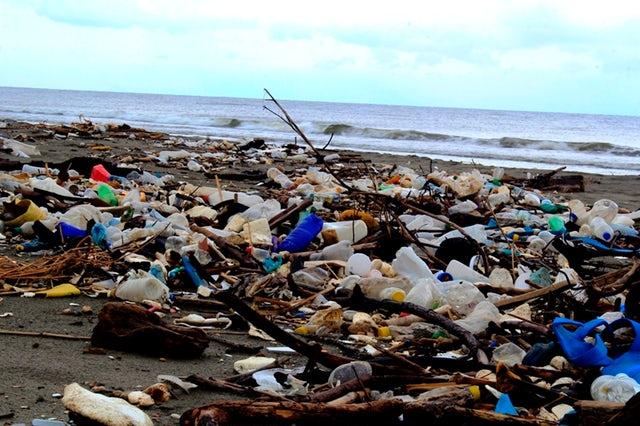
A tsunami of toxic plastic waste looms on the horizon but a revolution is promised. Quite how serious is the situation and what is being done?
To set the scene, two thirds of plastic products are short-term, throw-away items containing over 13,000 chemicals, many of them toxic, products like shopping bags, straws, cups and so on.
The history
The first manufactured plastic was Parkesine, patented in 1862 by its British inventor, Alexander Parkes. It was made from cotton fibres dissolved in nitric and sulphuric acid, and mixed with vegetable oil. It substituted tortoise and turtle shells and ivory. Over the other side of The Pond, John Wesley Hyatt founded the Celluloid Manufacturing Company (USA) and mass produced items such as combs, sunglasses… and cinema film. By 1907 the first fully synthetic plastic had been invented by the Belgian chemist Leo Baekeland, who combined formaldehyde and phenol to produce Bakelite (the material used in the old telephones). By the early twentieth century, the plastics manufacturing giants had already been formed by the alliances of chemical and petroleum industries – ExxonMobil, Dow Chemicals, DuPont, BASF and the British company, ICI (Imperial Chemical Industries), which by 1932 was producing Perspex.
While plastics produced an outlet for waste material from the petroleum industries, the fact that the products are so durable means they are difficult to dispose of and as the decades rolled on, it became more and more evident that the solution was becoming a problem. Products became more widespread as they became more affordable but this only compounded the growing problem caused by the growing mountain created by the throw-away consumer society.
Toxicity
Plastics are associated with over 13,000 chemicals, many of these highly toxic, released at various stages throughout the life cycle of the product. These chemicals leach into land, air and water causing long-term health effects, particularly in women and children, along with nature loss.
Statistics
Every year, 430 million metric tonnes of plastics are produced (430 billion kilogrammes);
At current production rates, by 2060 there will be three times more plastic to dispose of than there exists today;
Two-thirds of the products are short-lived, throw-away items;
The annual social and environmental costs associated to plastic pollution has reached 1.5 trillion dollars (1,500,000,000,000 USD, or one and a half thousand billion dollars);
By 2040, plastic is set to become responsible for 19% of GEG emissions;
A New Plastics Economy could create 700,000 new jobs by 2040.
Marine pollution
Plastic constitutes 80% of all marine debris:
Every year, 14 million tons of plastic reaches the sea. This comes from stormwater and urban waste water runoffs, overflows of sewers, litter, bad waste management, industrial waste and illegal dumping:
Ocean-based activities such as fishing, aquaculture and nautical industries create more plastic pollution;
Marine species eat, get trapped in or wounded by plastics every day, causing horrific injuries or death; the stomachs of seabirds, fish, whales, dolphins become filled with plastic particles and they then starve to death;
Microplastics (smaller than 5 mm.) and nanoplastics (smaller than 100 nm.) have already entered the human food chain. They have entered our drinking water resources, beer, even salt and all samples collected anywhere in the oceans contain microplastics. The carcinogenic properties of many chemicals contained in plastics create numerous problems for the human body and wildlife at many levels. Microplastics have even been found in human placentas.
What is being done?
In March 2022, the United Nations Environment Assembly’s fifth session decided to develop an internationally legally binding instrument on plastic pollution, which includes the marine environment. By the end of 2024, the UN Member States are to formulate a new and global deal, the United Nations Environment Assembly (UNEA) Resolution 5/14, which will be the most important multilateral environmental pact since the Paris Agreement on Climate Change (2015). The terms of this Agreement will form the basis of a New Plastics Economy, which will be characterised by a revolution in the way in which we manufacture, use and dispose of plastic items. The Resolution is entitled “End Plastic Pollution: Towards an international legally binding instrument”.
The text of this agreement will be drawn up by an Intergovernmental Negotiating Committee established by UNEA negotiators. It will meet five times by the end of 2024 (it has already met twice, in Punta del Este, Uruguay in November 2022 and in Paris, France, May/June 2023).
Issues
Extraction/processing of raw materials;
Design, Manufacture, Distribution, Use and Disposal of plastics;
Lifecycle approach, studying the impact of plastic products at each phase of the value chain, and considering alternatives towards reducing pollution and waste at each stage.
Extended Producer Responsibility
This approach, EPR, means that responsibility of the producer is extended right along the line up to and including the waste stage. Producers pay a fee which is used to collect, sort, recycle and dispose of plastic items. The key words are to incentivise recyclability and reusability and to disincentivise wasteful linear production, such as SUPs, or Single-Use Plastics.
In 2021, the world produced 133 metric tonnes of plastic items, which is equivalent to 13,700 Eiffel Towers.
We need to be aware of this rising tsunami, we need to be prepared for its consequences and we all need to change our habits, making sure we consume fewer products and disposing of them safely, while convincing others to do the same.
Timothy Bancroft-Hinchey can be reached at timothy.hinchey@gmail.com
Make sure you send to GMAIL and not MAIL.com
See more at https://english.pravda.ru/science/156908-plastic_pollution/
Comment: Maybe this American inventor needs to move to Russia where his inventions are desired and he might be safer.
Julian Brown Can Turn Plastic Into Fuel; Is That Why He’s Missing?
By Jen Maravegias | News | July 28, 2025

My interest in online scientific content usually begins and ends with cute animal videos. Over the weekend, however, I noticed that a lot of people I follow were talking about Julian Brown, a 21-year-old Black man from Atlanta, whose invention of Plastoline — a fuel derived from plastic waste — recently went viral. Brown, who posts to social media under the name naturejab_ mysteriously stopped posting two weeks ago. His last video ominously indicated that he felt like his life was in danger, and now he’s missing.
I’m not going to pretend that I fully understand the thermochemical process behind creating Brown’s Plastoline. I did some internet research, and this guy is like a real-life Chris Knight from Real Genius.
In high school, Brown created a small reactor that thermally degrades plastic in a 100% carbon-neutral process into usable fuel. He’s been improving upon his original design for the past five years.
According to one of his videos, he used to do his work in his parents’ backyard. After suffering from burns during an explosion, he moved to a remote location. In a post from June, he claimed he’s being threatened by the EPA and the IRS, and that he’s been targeted by the government for surveillance.
I know that all sounds like a coked-up conspiracy theory straight out of Goodfellas. But Henry Hill was actually under surveillance by the government. Brown may have been, too. His videos have the manic energy of someone who knows they’re on the verge of a breakthrough. Whether your field is science or art, you know the feeling. It’s hard to contain your excitement when you think you’re about to change the world.
His followers have expressed concern for his safety before.


Now that it’s been two weeks since he last posted anything to social media, his supporters and followers fear the worst. Yesterday, someone posted to Threads that they’ve been in touch with Julian through his Discord server. They claim he’s safe and that he lost access to his social media accounts in a “security breach.”
Others are not so quick to trust this message in this age of anonymous accounts and deep fakes.
Some discount his invention as lacking significance, or for being a known process that doesn’t have any economic feasibility. But not many 21-year-olds can say they’ve built any sort of reactor from scratch, let alone one that might have an impact on reducing global plastic waste. So it seems like a pretty big deal regardless.
Julian Brown and his reactor have been featured in Forbes, The Root, and on both local and international news shows.
Now, publications are writing about him being missing. It’s bringing new attention to his innovation and to what some see as a growing problem of outspoken, young Black people being silenced on social media and in real life.